
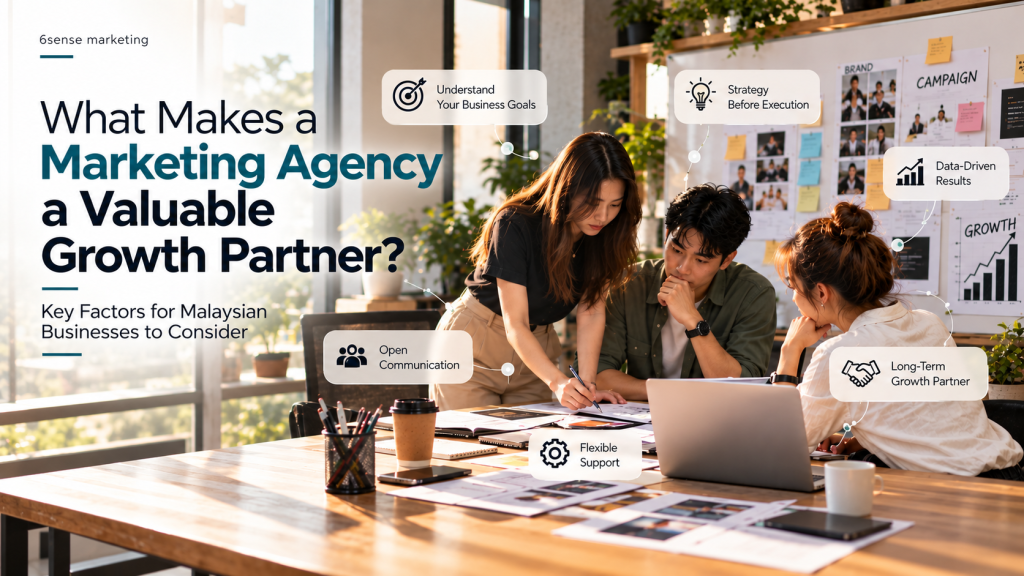
Choosing a marketing agency is an important decision for any business.
For many companies, especially small and medium-sized enterprises (SMEs), working with an external agency provides access to marketing expertise, creative resources, and strategic support without the need to build a large in-house team.
However, not all agency partnerships deliver the same value.
Some businesses work with agencies that focus mainly on producing content or managing advertisements, while others seek a partner who understands their business objectives and contributes to long-term growth.
The difference lies in how the relationship is approached.
A valuable marketing agency should do more than complete tasks. It should help businesses identify opportunities, solve challenges, and make informed marketing decisions.
So, what should businesses look for when choosing a marketing agency in Malaysia?
1. A Clear Understanding of Your Business Goals
A good marketing partnership begins with understanding the business, not immediately discussing deliverables.
Before recommending campaigns or marketing channels, an agency should take time to understand the company’s objectives, target audience, industry, and current challenges.
For example, a business aiming to increase brand awareness may require a different approach from one focused on generating qualified leads or improving sales conversion.
Without a clear understanding of these goals, marketing activities can become disconnected from actual business needs.
A strategic agency should be able to ask the right questions:
-
What are your primary business objectives?
-
Who are your ideal customers?
-
What challenges are affecting your growth?
-
What makes your products or services different?
-
How do you currently measure marketing performance?
These conversations help establish a clear direction and ensure that marketing decisions are aligned with the company’s priorities.
2. Strategy Before Execution
Marketing involves many activities, including social media management, content creation, advertising, SEO, branding, and lead generation.
However, having access to multiple services does not automatically create an effective marketing strategy.
The key is knowing how and when to use them.
A valuable marketing agency should be able to connect different activities into a structured plan based on the business’s goals and available resources.
For instance, a company looking to strengthen its online presence may need to improve its brand positioning, develop consistent content, optimise its website, and use digital advertising to reach relevant audiences.
Each activity should serve a purpose within the broader strategy.
When strategy comes before execution, businesses can avoid spending resources on activities that do not contribute meaningfully to their objectives.
3. The Ability to Combine Creativity with Data
Creativity is essential in marketing. Strong visuals, compelling messaging, and engaging content help brands capture attention and communicate their value.
However, creative execution should also be supported by performance data.
A campaign may generate impressive engagement, but businesses still need to understand whether it attracts the right audience, generates enquiries, or contributes to sales.
This is why a professional marketing agency should combine creative thinking with data-driven decision-making.
Performance metrics such as website traffic, cost per lead, conversion rate, audience engagement, and return on investment can help identify what is working and where improvements are needed.
Rather than relying entirely on assumptions, businesses can use these insights to refine their marketing activities over time.
The goal is not to choose between creativity and data, but to make both work together.
4. Transparent Communication and Reporting
Communication is one of the most important elements of a successful agency partnership.
Businesses should know what their agency is working on, why certain decisions are being made, and how marketing activities are performing.
Regular communication helps both parties stay aligned, address challenges early, and make adjustments when necessary.
A reliable agency should provide clear updates on:
-
Campaign progress and completed deliverables.
-
Marketing performance and key findings.
-
Challenges that require attention.
-
Recommended improvements.
-
Upcoming activities and priorities.
Reporting should also go beyond presenting numbers.
Instead of simply showing how many people viewed an advertisement, an agency should explain what those results mean and how they relate to the business’s objectives.
Transparency builds trust and allows businesses to participate actively in marketing decisions.
5. Flexibility as Your Business Grows
Business needs change over time.
A company that initially focuses on building brand awareness may later need to prioritise lead generation, product launches, or market expansion.
Its marketing strategy should evolve accordingly.
A valuable marketing partner understands that there is no single approach that works for every stage of business growth.
As priorities change, the agency should be willing to review existing strategies, explore new opportunities, and adjust its services based on actual needs.
For Malaysian SMEs, this flexibility can be particularly useful when managing limited budgets and resources.
Rather than committing to activities that no longer serve their objectives, businesses can work with their agency to focus on the areas that matter most at each stage.
6. A Partnership Built on Collaboration
A successful marketing agency relationship should not operate as a one-way service arrangement.
Businesses understand their products, customers, and industry realities better than anyone else. Agencies contribute marketing expertise, creative perspectives, and execution capabilities.
When both sides share information and collaborate openly, the resulting strategy is more likely to reflect the business’s actual needs.
This includes providing feedback, sharing customer insights, discussing campaign results, and making decisions together.
An agency should not simply wait for instructions, while a business should not expect the agency to work effectively without sufficient context.
The strongest partnerships are built on shared objectives, mutual trust, and consistent collaboration.
7. Long-Term Thinking Beyond Short-Term Campaigns
Short-term campaigns can generate immediate attention and enquiries, but sustainable business growth requires a broader perspective.
Brand awareness, customer trust, online visibility, and customer relationships take time to develop.
A marketing agency that focuses only on individual campaigns may overlook opportunities to build long-term brand value.
A growth-oriented partner considers how today’s marketing activities contribute to future business performance.
This may involve strengthening brand identity, developing a consistent content strategy, improving search visibility, nurturing potential customers, and maintaining a coherent customer experience across different platforms.
When marketing is approached as a long-term investment rather than a series of isolated tasks, businesses can build a stronger foundation for continued growth.
How Can the Right Marketing Agency Support Your Business?
For businesses looking to improve their marketing efforts, working with the right agency can provide access to a range of capabilities under one partnership.
Depending on their objectives, businesses may benefit from services such as:
-
Brand Strategy: Establishing a clear brand direction and positioning.
-
Brand Design: Creating a consistent and recognisable visual identity.
-
Digital Marketing: Strengthening online visibility across relevant channels.
-
Content Marketing: Developing valuable content that attracts and engages audiences.
-
Performance Marketing: Managing and optimising paid campaigns based on measurable objectives.
-
SEO: Improving search visibility and attracting relevant organic traffic.
-
Lead Generation: Building processes to attract and nurture potential customers.
Not every business needs all these services at once.
The right combination depends on the company’s goals, resources, target audience, and stage of growth.
A good agency helps businesses understand these priorities and develop a practical approach rather than simply recommending more services.
Conclusion
A valuable marketing agency is not defined solely by the number of services it offers or the amount of content it produces.
Its real value lies in understanding the business, providing strategic direction, communicating transparently, and helping the company make better marketing decisions.
For Malaysian businesses, choosing a marketing agency should be about finding a partner that can grow alongside the company, adapt to changing needs, and connect marketing activities with meaningful business outcomes.
Because the right marketing partnership is not just about getting work done. It is about building the direction, capabilities, and momentum needed for long-term growth.
6sense@joyce
